
A complete Wayland desktop built around personalization
Ferese is a window manager and desktop shell built together and configured in one place, for people who want their desktop to be their own. 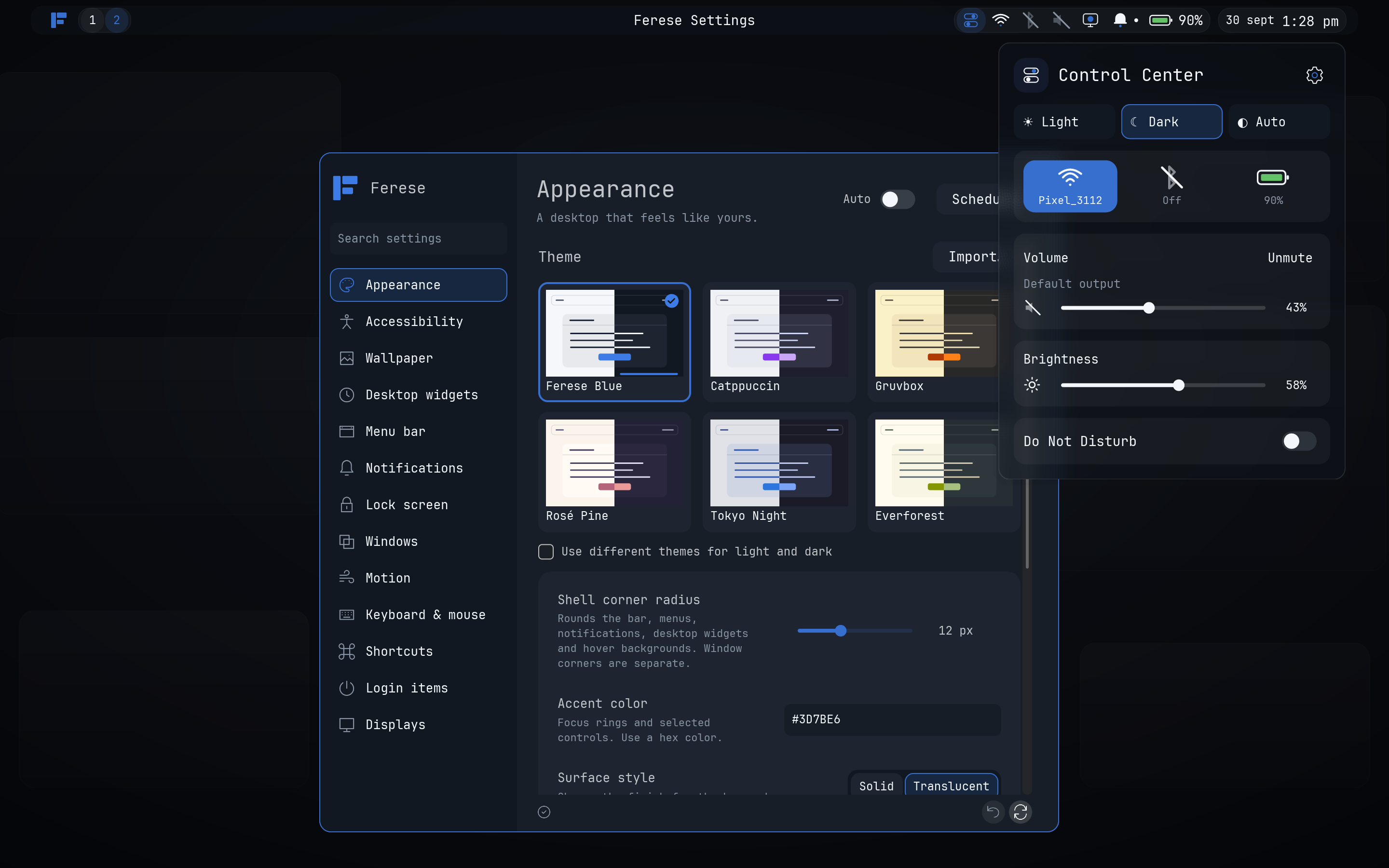 [View more screenshots](docs/screenshots.md) ## Features - Scrolling columns, tree tiling and floating windows, with an overview of all your workspaces - Keyboard shortcuts and touchpad gestures you can remap - Multiple monitors with fractional scaling - Themes, wallpapers, blur and corners that update live, with Light/Dark/Auto modes and custom KDL themes - Desktop widgets, including a clock and sticky notes - Screenshots with annotation, plus screen sharing and built-in recording - A built-in lock screen - Integrated Settings and Control Center for configuring your desktop ## Install Start with the [dependencies](docs/installation.md#requirements), then clone Ferese and build it as your normal user: ```sh git clone https://github.com/ferese-wm/ferese.git cd ferese ./scripts/install.sh ``` Once it’s installed, log out and choose **Ferese** at your login screen, or run `ferese-session` from a TTY or a greeter that accepts a command. The [installation guide](docs/installation.md) also walks you through previews, updates and recovery. ## Configure Make it yours through **Control Center → Settings** or `~/.config/ferese/config.kdl`, with changes applying as you make them and the last working configuration staying in place if an edit is invalid. The [configuration reference](docs/configuration.md) and [example config](packaging/config.kdl) cover everything from appearance and window layouts to displays and startup apps. ## Default shortcuts Use `Super`, usually the Windows key, to move around your desktop, and open **Settings → Shortcuts** whenever you want to change a shortcut or gesture. | Control | Action | | --- | --- | | Super + Enter | Open a terminal | | Super + H / J / K / L | Focus left / down / up / right | | Super + Backspace | Return to the last focused window | | Super + Escape | Toggle between the last two visited workspaces on this monitor | | Alt + Tab / Alt + Shift + Tab | Preview recent windows forward / backward; release Alt to select, Escape to cancel | | Super + F | Maximize the window | | Super + Shift + F | Toggle fullscreen | | Super + R | Cycle column width | | Super + Tab | Open overview | | Super + M | Switch scrolling / tree layout | | Print Screen | Capture the active monitor and open Satty | | Super + Shift + S | Select a screenshot area | | Super + Shift + E | Ask to log out | | Super + left-button drag | Move a floating window | | Super + right-button drag | Resize a floating window | | Three-finger swipe up / down | Next / previous workspace | | Three-finger swipe left / right | Focus the window to the right / left | Explore [all shortcuts and mouse actions](docs/shortcuts.md) for more ways to arrange your windows and move between workspaces. ## Documentation The [documentation index](docs/README.md) brings the desktop guides together, while [development instructions](docs/development.md) cover building, testing and contributing. Ferese is written in Rust using Smithay, with development happening [on GitHub](https://github.com/ferese-wm/ferese). If something goes wrong, [open an issue](https://github.com/ferese-wm/ferese/issues) with the steps to reproduce it and any relevant logs.